 Organic certified: DE-ÖKO-037

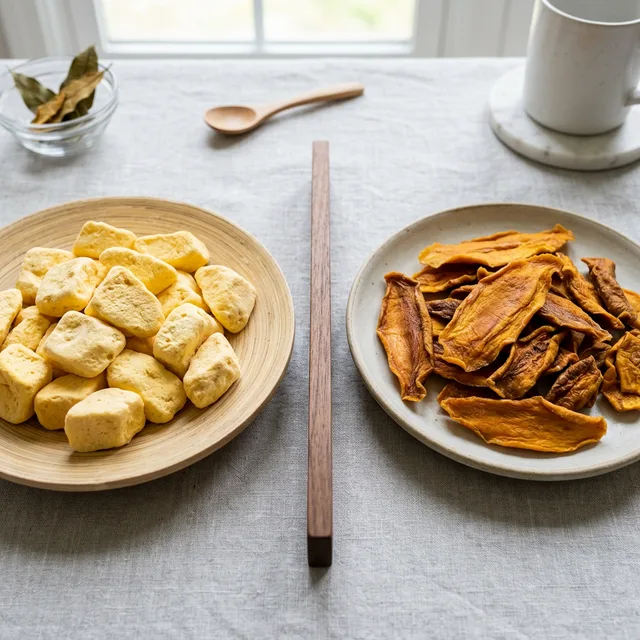
Both freeze-drying and dehydration remove moisture from food to extend shelf life, but they use fundamentally different processes with different outcomes. Here is a factual comparison to help consumers and B2B buyers understand the differences.
Processing Method
Dehydration uses circulating hot air (typically 50–70°C) to evaporate water content over 6–12 hours. Freeze-drying freezes the food to −40°C and then removes ice through sublimation in a vacuum chamber over 18–24 hours.
Side-by-Side Comparison
| Factor | Freeze-Dried | Dehydrated |
|---|---|---|
| Temperature | −30°C to −50°C | 50°C to 70°C |
| Moisture remaining | 1–4% | 10–20% |
| Texture | Crispy, light, airy | Chewy, dense |
| Shape retention | Original shape preserved | Shrinks significantly |
| Rehydration | Fast (seconds) | Slow (minutes/soaking) |
| Cost | Higher | Lower |
Quality and Appearance
The key advantage of freeze-drying is that the product keeps its shape and structure.
Which Method Is Better?
Freeze-drying is preferred when texture and appearance matter (for example snack fruits and ingredient powders).
At Manubolu, we use freeze-drying for our fruit slices and powders to keep the shape, colour and flavour of the product. Explore our range.
Sources
- Ratti, C. (2001). Hot air and freeze-drying of high-value foods. Journal of Food Engineering, 49(4), 311–319. doi.org
- Marques, L.G. & Freire, J.T. (2005). Freeze-drying of tropical fruits. Drying Technology, 23(6), 1357–1365.
- Fellows, P.J. (2017). Food Processing Technology, 4th Edition. Woodhead Publishing.
Disclaimer: This article is provided for general informational and educational purposes only. It does not constitute legal, nutritional, or medical advice. While we strive for accuracy, MANUBOLU Naturals assumes no liability for the completeness, accuracy, or timeliness of the information presented. Readers should consult qualified professionals for specific guidance. For official EU regulations, please refer to EUR-Lex. This content does not constitute health claims as defined by Regulation (EC) No 1924/2006.
Leave a Reply